10 Best No KYC Crypto Exchanges in 2026
Looking for the best no KYC crypto exchanges in 2026? This guide covers the top 10 non-KYC crypto exchanges, including centralized platforms and decentralized exchanges with no KYC requirements.
The list of truly anonymous crypto exchanges keeps getting shorter. Regulatory pressure from tax offices and financial regulators has pushed many platforms to adopt strict KYC requirements. Despite this, some exchanges still offer tiered or optional KYC, while others remain completely anonymous.
Key takeaways
Regulatory pressure has forced many exchanges to implement KYC, but some still offer anonymous trading
No KYC exchanges include both centralized platforms with tiered verification and fully decentralized options
Decentralized exchanges like Uniswap and PancakeSwap never require personal information
Centralized platforms often reserve the right to request KYC at any time, even without prior warning
Trading without KYC doesn't exempt you from tax obligations - crypto is taxable in most jurisdictions
Best no KYC crypto exchanges (full list for 2026)
These platforms offer users a high degree of privacy for trading cryptocurrencies without submitting personal identification documents. Here’s a complete no KYC crypto exchanges list for 2026, including both centralized and decentralized platforms.
|
Exchange |
Cryptocurrencies |
Custody? |
KYC? |
Location restrictions |
|
MEXC |
1600+ |
Custodial |
Tiered |
No US residents |
|
Bybit |
400+ |
Custodial |
Tiered |
No US residents |
|
dYdX |
35+ |
Hybrid |
None |
No US or Canadian residents |
|
PrimeXBT |
5+ |
Custodial |
None |
No US residents |
|
Uniswap |
900+ |
Non-custodial |
None |
None |
|
PancakeSwap |
50+ |
Non-custodial |
None |
None |
|
HODL HODL |
1 |
Non-custodial |
None |
None |
|
Pionex |
330+ |
Custodial |
Tiered |
None - but products may be restricted |
|
ProBit |
400+ |
Custodial |
Tiered |
No US residents |
|
Margex |
50+ |
Custodial |
None |
No US, Canada, or Hong Kong residents |
What is KYC in crypto?
KYC, or Know Your Customer, is a verification process that crypto exchanges use to confirm the identity of their users. It's a legal requirement in most jurisdictions, designed to prevent money laundering, tax evasion, and the financing of illegal activities.
Most centralized exchanges require some form of KYC. This means uploading government-issued ID, proof of address, and sometimes even a selfie. While it might feel invasive, KYC helps exchanges comply with anti-money laundering regulations and, in many cases, protects your funds from theft or fraud.
What are the best no KYC crypto exchanges?
Here are the top no KYC crypto exchanges for 2026. Some offer truly anonymous trading, while others use tiered systems that don't require KYC until you hit certain limits. This includes both centralized platforms and decentralized exchanges with no KYC, which never require identity verification.
MEXC
MEXC doesn't enforce mandatory KYC upfront, but it's not exactly a free pass either. The platform offers three account tiers like unverified, primary KYC, and verified plus. Unverified users can withdraw up to 10 BTC every 24 hours.
Some users have recently reported being asked to complete verification before withdrawing funds, and in certain regions, there's a 1000 USDT trading limit before KYC kicks in. If you're in the US, MEXC isn't available as of late 2023.
Key features
-
Over 1600 cryptocurrencies available for trading
-
Low trading fees
-
Spot, P2P, futures, leveraged ETFs, and crypto savings products
-
Up to 10 BTC daily withdrawal limit for unverified accounts
-
Available globally except in restricted jurisdictions
Limitations
-
KYC may be required at any time without warning
-
US users cannot access the platform
-
Some regions face trading limits before verification is required
-
Using a VPN to bypass restrictions can result in account suspension
-
Withdrawal limits can be paused until verification is complete
Bybit
Bybit doesn't require KYC to open an account or start trading, but there are strings attached. Non-KYC users can withdraw up to 20,000 USDT per day, but you won't have access to fiat deposits or withdrawals. Features like earn products and staking are also off limits.
Currently, Bybit isn't available to users in the United States. Yes, using a VPN might seem like a workaround, but if you get caught, your account could be suspended.
Outside of restricted regions, Bybit is one of the largest exchanges in the world by trading volume. It supports more than 400 cryptocurrencies and major fiat currencies, including USD, EUR, GBP, AUD, and CAD.
Bybit No KYC Limits (2026)
Bybit allows limited trading and withdrawals without KYC, but there are restrictions on withdrawal limits and features.
Read full breakdown: Bybit No KYC Limits 2026
Key features
-
More than 400 cryptocurrencies are supported
-
Spot and margin trading, leveraged tokens, derivatives
-
Passive income products, including savings accounts and liquidity mining
-
Up to 20,000 USDT daily withdrawal for non-KYC accounts
-
Major fiat currency support
Limitations
-
No fiat deposits or withdrawals without KYC
-
Earn products and staking require verification
-
Not available to US residents
-
Bybit may request KYC at any time for withdrawals
dYdX
There's no KYC on dYdX. Period. There's no KYC on dYdX. Period. As a decentralized platform, dYdX is often considered a decentralized perpetual futures DEX with no KYC exchange. All you need to get started is a non-custodial wallet like MetaMask, Trust Wallet, Coinbase Wallet, or any WalletConnect-compatible option. dYdX is also one of the leading no KYC crypto perpetual trading platforms, offering advanced derivatives trading without identity verification.
Currently, dYdX isn't available to users in the US or Canada. If you're based elsewhere, you're in luck. The platform offers perpetual contract trading on over 35 cryptocurrencies with leverage, so it's best suited for traders who know what they're doing.

Key features
-
No KYC required at all
-
A hybrid decentralized exchange built on blockchain technology
-
Perpetual contract trading with leverage on 35+ cryptocurrencies
-
Connect via non-custodial wallets like MetaMask, Trust Wallet, Coinbase Wallet, etc.
-
Advanced trading tools for experienced investors
Limitations
-
Not available to US or Canadian residents
-
High-risk trading with leverage
-
Requires understanding of perpetual contracts and derivatives
-
Limited to 35 cryptocurrencies compared to larger exchanges
-
No customer support in the traditional sense
PrimeXBT
PrimeXBT doesn't require KYC by default. Users can trade and withdraw crypto without verification, with a 24-hour withdrawal limit of 20,000 dollars and a deposit limit of 2,000 dollars. PrimeXBT is available in many regions worldwide, though availability varies depending on local regulations.
Unlike most crypto platforms, PrimeXBT also offers access to traditional markets. Users can trade not only crypto but also forex, commodities, CFDs, and stock indices. The crypto selection is smaller than most, with major assets like Bitcoin, Ethereum, Litecoin, XRP, and EOS.

Key features
-
No mandatory KYC for crypto trading
-
Access to traditional markets like forex, commodities, CFDs, stock indices
-
Strong privacy stance though verification may be requested
-
Available in many regions globally
Limitations
-
Small crypto selection
-
Fiat deposits and withdrawals may be restricted
-
Not available in some jurisdictions due to local regulations
-
Daily deposit and withdrawal limits for non-verified accounts
Uniswap
Uniswap is the largest decentralized exchange, with a total value locked of more than $4 billion. As a DEX, all you need to get started is a non-custodial wallet with funds. There's no KYC, and at no point will Uniswap ask for your personal details.
Investors can trade Ethereum and ERC-20 tokens at speed with minimal slippage, as well as other native cryptocurrencies and tokens on blockchains including BNB Chain, Optimism, and Polygon.

Key features
-
Largest decentralized exchange with over $4 billion TVL
-
No KYC required ever
-
Trade Ethereum and ERC-20 tokens with minimal slippage
-
Support for multiple blockchains (BNB Chain, Optimism, Polygon)
-
Liquidity provision for earning passive income
-
Connect via any non-custodial wallet
Limitations
-
Decentralized interface can be confusing for beginners
-
Gas fees can be high during network congestion
-
No customer support
-
Limited to tokens on supported blockchains
-
Requires understanding of wallet management and blockchain technology
PancakeSwap
PancakeSwap is the most popular decentralized exchange for BNB Chain, allowing investors to trade BNB and other BEP-20 tokens easily. All you need to get started is a non-custodial wallet like Trust Wallet. As a DEX, PancakeSwap will never ask you for personal details, and no KYC is necessary.
Beyond trading, there are multiple investment opportunities on the platform, including liquidity provision, farming, staking, and even a lottery. PancakeSwap has built a strong community and offers a more user-friendly experience compared to some other DEXs, making it a solid choice for traders who want privacy without complexity.
Key features
-
Most popular DEX for BNB Chain
-
No KYC required
-
Trade BNB and BEP-20 tokens easily
-
Multiple earning opportunities like liquidity provision, farming, and staking
-
User-friendly interface compared to other DEXs
Limitations
-
Limited to BNB Chain and BEP-20 tokens
-
Gas fees on BNB Chain
-
No customer support
-
Requires a non-custodial wallet
-
DeFi risks, including impermanent loss and smart contract vulnerabilities
HODL HODL
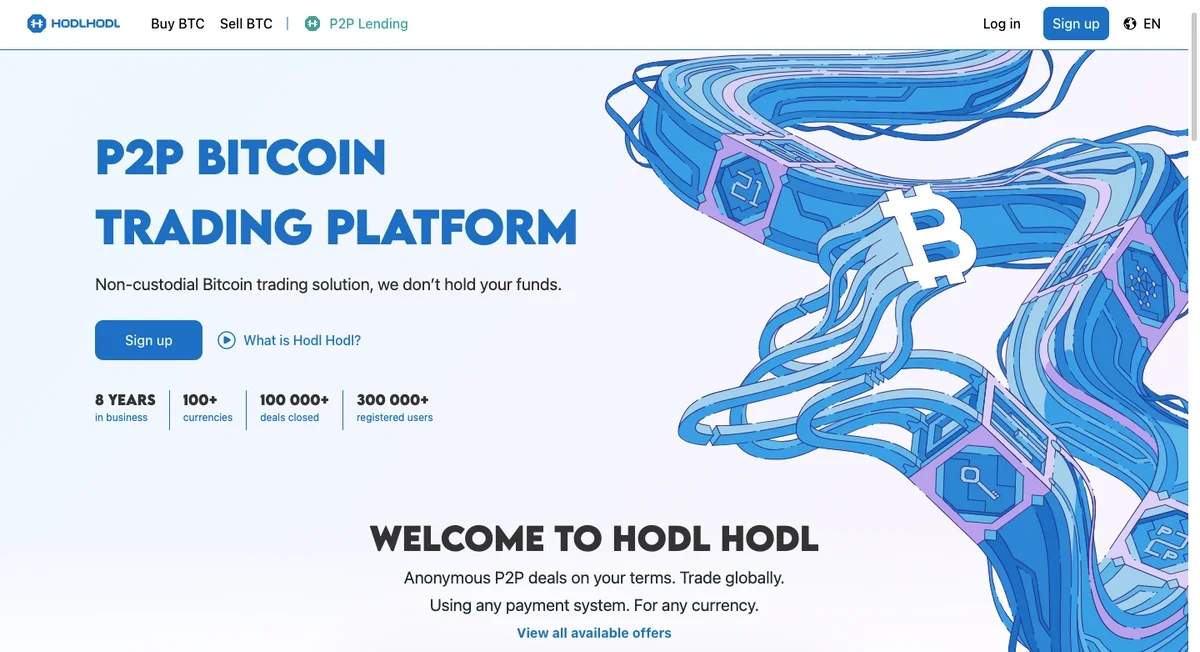
HODL HODL is one of the best no KYC P2P crypto exchanges for Bitcoin trading. It's a non-custodial Bitcoin trading solution that allows users to trade directly with each other without holding user funds. Instead, any funds traded on the platform are locked in multi-sig escrow, minimizing the possibility of theft and reducing trading time for users.
As a peer-to-peer trading site, there are no withdrawal limits, but there are limits to the number of contracts, active offers, and volume allowed for a single trade.
Key features
-
Non-custodial peer-to-peer Bitcoin trading
-
No KYC required at all
-
Multi-sig escrow for secure trading
-
No withdrawal limits
-
Accessible globally without restrictions
-
Direct peer-to-peer trades without intermediaries
Limitations
-
Only supports Bitcoin and no other cryptocurrencies
-
Limits on the number of contracts and active offers
-
Volume limits per single trade
-
P2P trading can take longer than centralized exchanges
-
Requires understanding of escrow and multi-sig systems
Pionex
Pionex requires KYC, but the process is simple. Users can access basic features with Level 1 KYC, which only asks for your name and country. Unverified accounts are limited, but Level 1 lets you trade, deposit crypto and fiat, and withdraw USD, all within certain limits.
Pionex is available to US users, although a few features are off the table. You get 330+ coins and free automated trading bots, making it ideal for beginners and quant-style traders.

Key features
-
Over 330 cryptocurrencies supported
-
Free crypto trading bots for automation
-
Available to US users
-
Deposit crypto and fiat, withdraw USD within limits
-
No coding required for automated trading strategies
Limitations
-
Level 1 KYC still requires some personal information
-
US users cannot access leveraged products
-
Withdrawal and trading limits for lower verification levels
-
May request additional verification at any time
-
Automation requires learning how to use trading bots effectively
ProBit
ProBit uses a tiered KYC system. Level 1 requires only email verification and gives access to basic features like deposits, trading, staking, and withdrawals up to 5,000 dollars. As with many exchanges, ProBit may request KYC at any time, regardless of level.
The platform supports over 400 cryptocurrencies and also offers staking, earn products, and initial exchange offerings. If you're outside the US and looking for a low-barrier exchange with decent volume and variety, ProBit could be a good fit.
Key features
-
Email verification only for Level 1
-
Basic trading, deposits, staking up to 5,000 dollars, withdrawals
-
Access to IEOs with Level 2 verification
-
Staking and earn products available
-
Good variety and decent trading volume
Limitations
-
Not available to US residents
-
ProBit may request full KYC at any time
-
Level 1 limits withdrawals to 5,000 dollars
-
Smaller exchange with potentially lower liquidity than major platforms
Margex
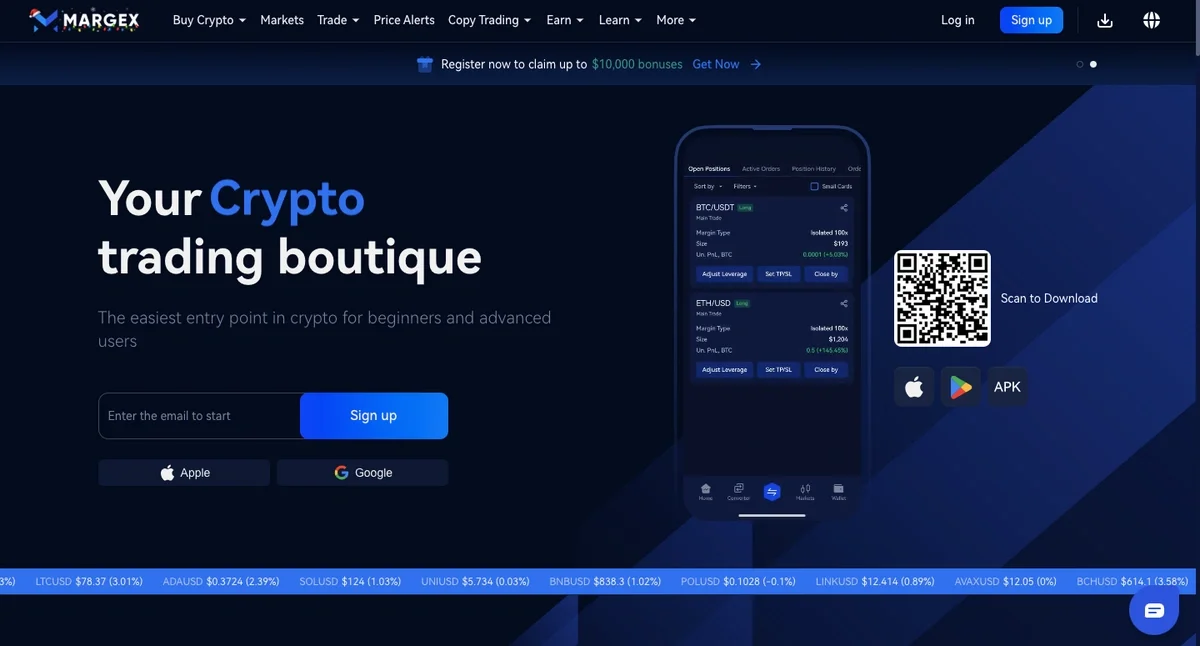
Margex doesn't require KYC for account creation or crypto trading. Users can sign up with just an email address and start trading derivatives with up to 100x leverage.
The platform supports over 50 cryptocurrencies and offers features like copy trading and staking. Margex is not available in the United States, Canada, Hong Kong, or several other restricted jurisdictions.
Key features
-
No KYC required for account setup and basic trading
-
Copy trading feature for beginners
-
Staking options for passive income
-
Low trading fees, 0.019% maker, 0.06% taker
-
Demo account available for practice
Limitations
-
Unregulated platform with no financial authority oversight
-
Large withdrawals may trigger mandatory KYC
-
Not available in US, Canada, Hong Kong, and other jurisdictions
-
Limited to derivatives trading
-
Customer support issues reported by some users
Read next: Top crypto exchanges to use in the USA
How to choose the best no KYC crypto exchanges?
Choosing a no KYC exchange comes down to balancing privacy, features, and risk tolerance. Here are a few things to consider:
- Centralized vs decentralized. Centralized exchanges like MEXC or Bybit offer more features and liquidity, but can request KYC at any time. Decentralized exchanges like Uniswap and PancakeSwap never ask for personal information but require you to manage your own wallet and understand DeFi.
- Withdrawal limits. Many no KYC exchanges set limits on how much you can withdraw without verification. If you're planning to move large amounts, check the limits before signing up.
- Regional restrictions. Most no KYC exchanges block users from the US and other heavily regulated regions. Make sure the platform accepts users from your location.
- Reputation and security. Not all no KYC exchanges are created equal. Some have strong security measures and clean track records, while others have been accused of exit scams or freezing accounts.
- Features and asset selection. If you're just looking to swap tokens, a simple DEX might work. But if you want advanced trading tools, derivatives, or staking, you'll need a centralized platform with more features.
At the end of the day, no KYC exchanges offer privacy, but they also come with risks. Make sure you understand what you're getting into before you trade.
Do I have to report my transactions on no KYC crypto exchanges?
Even if you're using no KYC crypto exchanges, most tax offices have released clear guidance that crypto is subject to tax, and any attempt to avoid tax on cryptocurrency is tax evasion and a criminal offense with steep penalties.
The IRS and tax offices around the world are cracking down on crypto, with dedicated operations to match wallet addresses with identities. So even if you've got away with not paying tax on your crypto for now, it's inevitable that your tax office will catch up with you eventually.
Trading without KYC doesn't mean trading tax-free. Your capital gains, losses, and income from crypto are still taxable, regardless of whether you provided ID to an exchange.
Verdict: Best No KYC Crypto Exchanges in 2026
The best no KYC crypto exchanges in 2026 depend on your needs.
- For full privacy: Uniswap, PancakeSwap (no KYC ever)
- For advanced trading: Bybit, dYdX (derivatives, higher liquidity)
- For no KYC P2P Bitcoin trading: HODL HODL
- For variety and altcoins: MEXC
If you want complete anonymity, decentralized exchanges are the safest option. For more features and liquidity, centralized platforms with no mandatory KYC can still work, but come with risks.
How Blockstats can help with crypto tax
Blockstats makes it easy to manage your crypto taxes, whichever exchange, wallet, or blockchain you're using. Our AI-powered crypto tax calculator supports all of the exchanges mentioned above, as well as hundreds more.
All you need to do is connect your exchange with Blockstats via API or by importing a CSV file of your transaction history. Our AI-powered features automatically categorize your transactions, identify missing data, and optimize your tax position.
Once you've done this, you'll be able to find all the information you need about your crypto capital gains, losses, income, and expenses under your tax summary. You can also download specific tax reports based on your location, including crypto tax reports for the IRS, ATO, HMRC, and CRA (and many more).
Frequently asked questions
Why use a non-KYC exchange in 2026?
Privacy, speed, and accessibility. No KYC exchanges let you trade without sharing personal information or waiting for approval.
Are non-KYC exchanges safe?
It depends. Decentralized exchanges are generally safer from hacks, but centralized no KYC platforms often lack regulatory oversight and customer protection. If you are looking for the safest crypto exchange, the safety depends on regulation, security, and insurance. Regulated exchanges like Coinbase and Kraken offer strong protection, while DEXs eliminate custody risks.
What are the best no KYC crypto exchanges in 2026?
The best no KYC crypto exchanges in 2026 include platforms like MEXC, Bybit, dYdX, PrimeXBT, Uniswap, and PancakeSwap. These platforms offer varying levels of anonymity, from fully decentralized exchanges with no KYC requirements to centralized exchanges with tiered verification limits.
Will the government crackdown on non-KYC exchanges?
Most likely, yes. Regulators are increasing pressure on anonymous platforms, as seen with TradeOgre's shutdown in 2026. Expect more enforcement. Tax authorities use blockchain analysis to match wallet addresses with identities, even without KYC data from exchanges.
Are there decentralized crypto exchanges with no KYC?
Yes, decentralized exchanges with no KYC, like Uniswap and PancakeSwap, never require identity verification. You can trade directly from your wallet, making them the most private option compared to centralized exchanges.
Can I buy Bitcoin on no KYC crypto exchanges?
Yes, you can buy Bitcoin on no KYC crypto exchanges, especially through peer-to-peer platforms like HODL HODL. These platforms allow direct trades between users without requiring identity verification.
Is there a way to buy crypto without KYC?
Use decentralized exchanges like Uniswap or centralized platforms with tiered KYC like MEXC or Bybit below withdrawal limits.
Can I withdraw crypto without KYC?
Yes, you can withdraw your crypto but with limits. Platforms like MEXC (10 BTC), Bybit (20,000 USDT), and PrimeXBT (20,000 USD) allow withdrawals without verification.
Can I use Binance without KYC?
No. Binance requires KYC for all users. Previously, unverified accounts had limited features, but that's no longer the case.
Is there an anonymous crypto exchange?
Truly anonymous options include decentralized exchanges like Uniswap, PancakeSwap, and HODL HODL, which never collect personal information.
How do I buy BTC with no verification?
You can use no kyc crypto exchanges. Use a DEX like Uniswap (swapping for wrapped BTC) or a P2P platform like HODL HODL for direct trades.
Is there a crypto exchange with no SSN?
No KYC exchanges don't require Social Security Numbers. Options include MEXC, Bybit, Uniswap, and PancakeSwap.
How can you get around wallet verifications on exchanges?
You can't bypass verification on exchanges that require it. Instead, use no KYC platforms or decentralized exchanges from the start.
What happened to TradeOgre?
TradeOgre was shut down by Canadian authorities in September 2025 after a year-long investigation found it violated financial laws by not registering with FINTRAC and failing to verify users. The Royal Canadian Mounted Police seized over $56 million CAD in assets, marking Canada's largest crypto seizure and first complete exchange shutdown.