Best Crypto Exchanges USA (2026)
The crypto in the United States has shifted dramatically. What was once a maze of uncertainty is now a more structured environment, making it easier for traders and investors to participate with confidence. But with dozens of platforms competing for attention, picking the right exchange still isn't simple. This guide cuts through the noise by reviewing the top U.S. crypto exchanges based on fees, security, features, and state availability.
Key takeaways
Coinbase: Best for beginners who prioritize ease of use, strong compliance, and educational tools
Kraken: Best for advanced traders seeking deep liquidity, futures, and margin trading
Crypto.com: Best all-in-one platform for yield seekers with staking, DeFi, and rewards
Robinhood: Best for casual investors combining stocks and large-cap crypto in one app
Gemini: Best for security-conscious traders who value transparency and cold storage
No single platform fits everyone, match your choice to your priorities: fees, features, or security
Best USA crypto exchanges: Comparison overview
The following table provides a side-by-side comparison of the top crypto exchanges available to users in the United States.
|
Exchange |
Fees |
Supported Cryptocurrencies |
Payment Methods |
Best For |
|
Coinbase |
0.40% - 0.60% maker/taker |
343+ |
Bank transfer, debit/credit card, PayPal |
Beginners, regulated trading |
|
Kraken |
0.16% - 0.26% maker/taker |
200+ |
Bank transfer, card, crypto |
Advanced traders, futures |
|
Crypto.com |
0.075% - 0.075% maker/taker |
400+ |
Bank transfer, card, Apple/Google Pay |
Yield seekers, all-in-one |
|
Robinhood |
$0 commissions (spreads apply) |
50+ |
Bank transfer, instant deposit |
Stock + crypto combo |
|
Gemini |
0.20% - 0.40% maker/taker |
160+ |
Bank transfer, debit card, wire |
Security-first traders |
What are the best crypto exchanges in the USA?
Each platform brings something different to the table. Some prioritize low fees, others focus on security or beginner-friendly design. Here's how the top exchanges stack up for U.S. users.
Coinbase
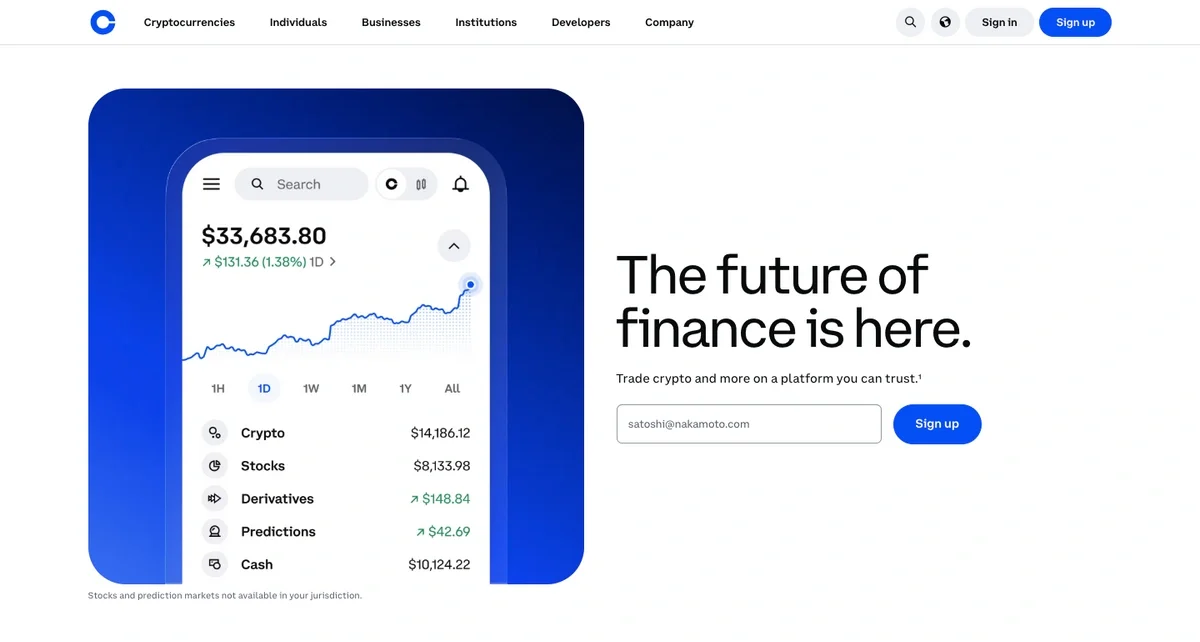
Coinbase remains the go-to platform for new users entering the U.S. crypto market. It's built around simplicity, strong regulatory compliance, and a polished interface that makes buying your first Bitcoin feel effortless. With over 343 assets listed and availability in 100+ countries, it's designed for broad accessibility without sacrificing security standards.
Key features
-
Staking rewards are available on select coins like Ethereum, Solana, and Cardano
-
Advanced Trade platform with pro-level charting tools and customizable order types
-
Educational content through Coinbase Learn, including earn-style quizzes that reward users with crypto
-
Coinbase Card (available in select regions) for spending crypto like cash
-
Mobile and web apps optimized for iOS and Android with real-time price alerts
Pros and Cons
|
Pros |
Cons |
|
Top-tier security and compliance |
Higher spot fees vs. competitors |
|
Clean, beginner-friendly interface |
Steep spreads on instant buys |
|
Staking and learn-to-earn programs |
Limited advanced tools beyond Advanced Trade |
|
Deep liquidity across major pairs |
Strict KYC; some US states have restrictions |
Kraken
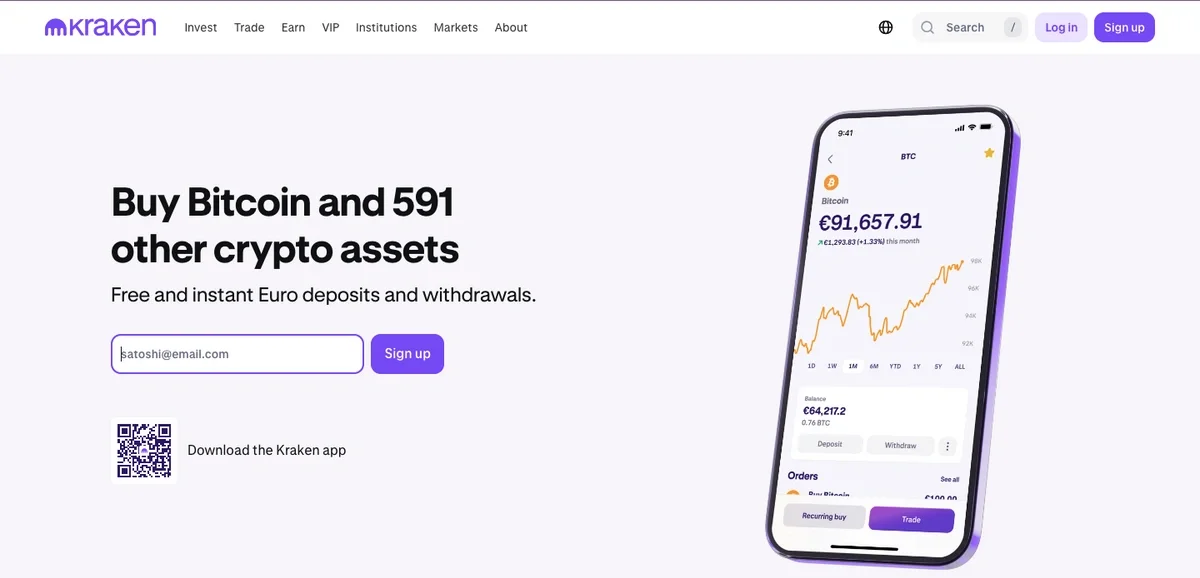
Kraken has built its reputation on security, transparency, and advanced trading features. Launched over a decade ago, it's never been hacked and remains one of the few platforms offering margin and futures trading to U.S. users. With 200+ cryptocurrencies and 700+ trading pairs, it caters to both retail and institutional traders who need depth and flexibility.
Key features
-
Advanced trading options including 5x margin and 50x futures leverage
-
Staking and earn programs for passive income on supported assets
-
OTC desk for large block trades with minimal slippage
-
Paper trading available for testing strategies without risking capital
-
Pro-level charting with technical indicators and customizable layouts
Pros and Cons
|
Pros |
Cons |
|
Advanced trading with futures and margin |
Unavailable in New York, Washington, Maine |
|
High security; never hacked |
Instant buy fees are higher than competitors |
|
Public Proof of Reserves and strong compliance |
Fewer altcoins compared to Binance or Crypto.com |
|
Competitive fee structure for active traders |
Pro features require higher KYC verification |
Crypto.com
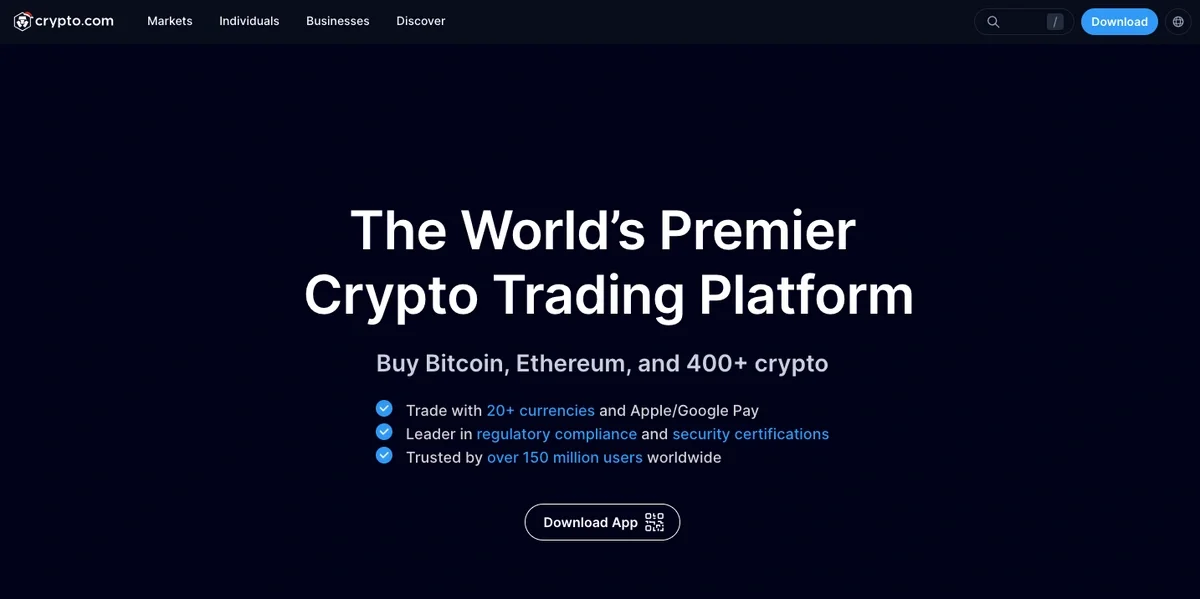
Crypto.com stands out as an all-in-one platform with one of the broadest feature sets in the industry. From staking and lending to a Visa card and DeFi wallet, it's built for users who want more than just spot trading. With 400+ assets and aggressive international expansion, it's a strong option for yield-focused traders and those looking to maximize rewards through its native CRO token.
Key features
-
Crypto Visa card offering cashback rewards and perks tied to CRO staking levels
-
Earn platform for lending and staking with competitive APYs on major coins
-
Copy trading for users who want to mirror successful traders
-
Margin and derivatives trading with spot, futures, and options available
-
DeFi wallet with self-custody and access to decentralized protocols
Pros and Cons
|
Pros |
Cons |
|
Broadest feature set (Earn, DeFi, Card) |
Busy interface can overwhelm new users |
|
Deep liquidity and low fees with CRO staking |
CRO staking needed for best discounts |
|
24/7 live customer support |
Not all features available in the US |
|
Global fiat on/off ramps |
Reports of slow fiat withdrawals |
Robinhood
Robinhood isn't a traditional crypto exchange, but it's a popular entry point for U.S. users who want to combine stock and crypto investing in a single, streamlined app. With commission-free trades and a sleek mobile interface, it's built for simplicity. However, it lacks the depth and flexibility of a full-featured exchange, offering only crypto-to-USD pairs and no staking or advanced trading tools.
Key features
-
Stocks, ETFs, and 50+ top cryptocurrencies in one app
-
Commission-free trades with no explicit trading fees (spreads and payment for order flow apply)
-
Recurring investments for dollar-cost averaging into crypto
-
API access for advanced users building custom trading strategies
-
Mobile and web platforms optimized for beginners
Pros and Cons
|
Pros |
Cons |
|
Cleanest interface for stocks + crypto |
No crypto-to-crypto trading |
|
$0 commissions with fractional crypto |
Smaller coin selection vs. full exchanges |
|
Strong educational content |
Past security issues and regulatory fines |
|
FDIC-insured USD balances |
No live customer support |
Gemini
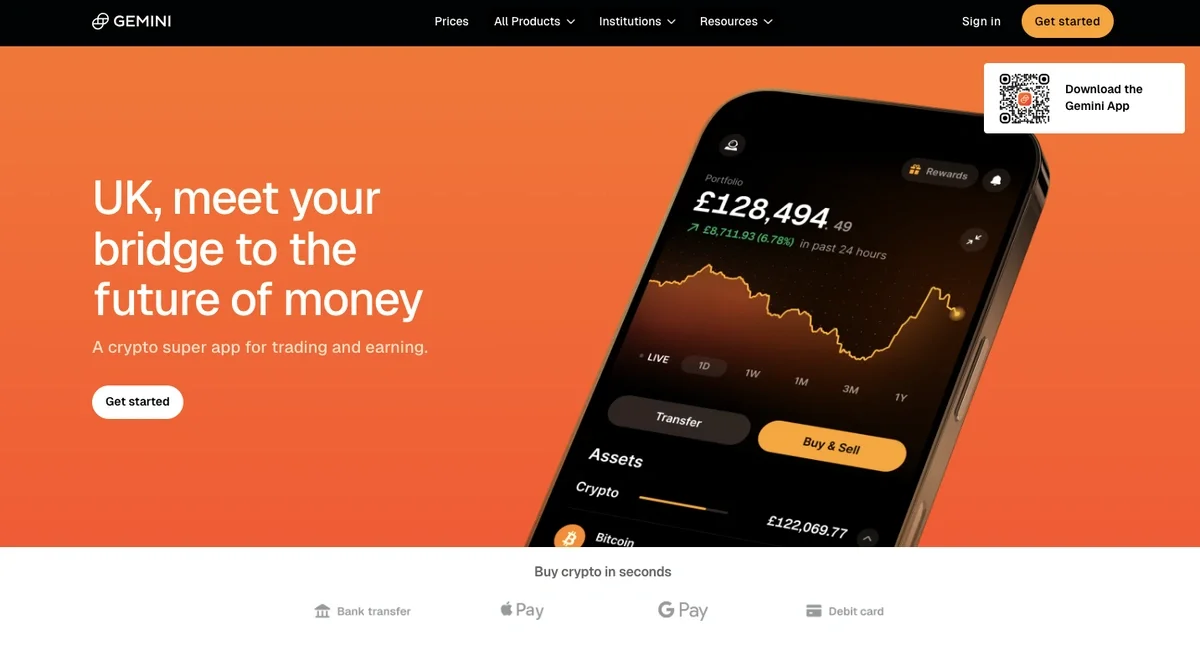
Gemini has earned its place as one of the most security-conscious exchanges operating in the U.S. Founded by the Winklevoss twins, it's known for transparency, cold storage, and being the first U.S. exchange to achieve SOC 2 Type II certification. With 160+ cryptocurrencies, staking options, and a dual-market ActiveTrader interface, it appeals to traders who refuse to compromise on asset protection.
Key features
-
Crypto staking available on assets like Solana and Ethereum (geo-restricted in New York)
-
ActiveTrader platform with advanced charting, dual-market comparison, and multiple fiat pairs
-
Cryptopedia learning hub and in-app demos for educational support
-
Dual-market charts for comparing global prices across different exchanges
-
USD, GBP, EUR, and AUD fiat pairs available
Pros and Cons
|
Pros |
Cons |
|
Highest security standards (SOC 2, cold storage) |
Fewer coins vs. Binance or Crypto.com |
|
Staking and earn |
Staking limited by geography |
|
Dual-market charting and global fiat pairs |
Higher fees for casual users |
|
Transparent audits and insurance |
Slower onboarding for institutions |
Read next: Top No KYC crypto exchange for 2026
How to choose the right U.S. crypto exchange in 2026
Choosing the right exchange isn't about picking the most popular name in the U.S. It's about matching the platform to your goals, trading style, and location.
Check the number of supported assets. If you're focused on Bitcoin and Ethereum, most exchanges will work. But if you're exploring altcoins, NFTs, or niche tokens, you'll need a platform with a deeper catalog.
Fees also add up quickly, especially if you're an active trader. Pay attention to maker and taker fees, deposit methods, withdrawal costs, and whether the platform offers volume discounts or token-based fee reductions.
User experience matters more than it seems. A clean interface speeds up execution and reduces mistakes, while clunky navigation can cost you money in fast-moving markets. If you plan to earn passive income, confirm that staking or yield programs are available in the state, you live.
For traders interested in leverage or derivatives, verify what's accessible to U.S. users. Many platforms restrict futures, margin, and perpetual contracts due to regulatory constraints.
Additionally, do not forget about security. Look for platforms with Proof of Reserves, cold storage policies, insurance coverage, and proper licensing.
What's the safest U.S. crypto exchange?
“Safest” often means transparent custody, audited reserves, and a long security record. Kraken and Gemini are widely regarded as top choices for security-conscious users, with Coinbase close behind for institutional-grade controls.
- Gemini leads on security with SOC 2 Type II certification, nearly 100% cold storage, FDIC-insured hot wallets, and transparent audits published in its Trust Center.
- Coinbase follows closely with 98% of assets in cold storage, FDIC insurance on USD balances up to $250,000, regular Proof of Reserves audits, and insurance on online wallets. It's registered with FinCEN and NYDFS and maintains SOC 2 compliance.
- Kraken stores 95%+ of assets in cold storage, publishes Proof of Reserves, and operates a bug bounty program. Licensed by FinCEN, the FCA, and FINTRAC, it maintains ISO and SOC 2 certifications (in progress).
All three platforms have strong track records, but if security is your top priority, Gemini and Kraken edge out the competition with their transparent audit practices and regulatory rigor.
Why are many crypto exchanges unavailable in the USA?
The U.S. regulatory environment is one of the most complex and expensive to navigate in the world. Many exchanges avoid it entirely because the cost and legal risk outweigh the potential revenue.
U.S. crypto exchanges face complex, fragmented regulation. Federally, they must register with FinCEN as Money Services Businesses and comply with AML/KYC. Most states require separate money-transmitter licenses, with New York's BitLicense being particularly restrictive.
Oversight is split between the SEC (securities) and CFTC (derivatives/commodities), creating legal ambiguity. Strict tax reporting, banking limits, and enforcement threats further deter platforms. Operating in the U.S. results in higher compliance costs, slower product launches, and fewer features compared to international offerings.
Why are some of the exchange features restricted in the USA?
Despite the passage of the GENIUS Act in 2025, the U.S. remains a bifurcated market. Features like high-leverage futures and certain yield-bearing "Earn" products are restricted because they trigger SEC (securities) or CFTC (derivatives) oversight.
To operate legally in the U.S., exchanges often "geofence" these high-risk features to protect retail investors.
Because each product must satisfy federal and state-level requirements simultaneously, exchanges often choose to disable features. That's why U.S. users typically see fewer coins and more restrictive onboarding compared to global versions of the same platform.
Who Regulates USA Crypto Exchanges?
There's no single regulator overseeing crypto in the United States. Instead, oversight is split across multiple agencies, each with authority over different aspects of the market.
FinCEN (Financial Crimes Enforcement Network) requires exchanges to register as Money Services Businesses (MSBs) and comply with AML and KYC rules.
SEC (Securities and Exchange Commission) regulates digital assets classified as securities, including token offerings, staking-as-a-service, and certain yield products.
IRS (Internal Revenue Service) enforces tax reporting requirements on crypto transactions and holdings.
CFTC (Commodity Futures Trading Commission) oversees crypto derivatives like futures, options, and leveraged trading on assets deemed commodities, such as Bitcoin.
OCC (Office of the Comptroller of the Currency) supervises banks offering crypto custody or related financial services.
CFPB (Consumer Financial Protection Bureau) monitors crypto activity tied to consumer protection and financial disclosures.
FTC (Federal Trade Commission) enforces advertising standards and consumer protection in crypto marketing.
State regulators issue money transmitter licenses and crypto-specific licenses like New York's BitLicense.
FINRA (Financial Industry Regulatory Authority) oversees broker-dealer activity, which can become relevant for exchanges offering securities or tokenized assets.
Because authority is fragmented, exchanges must navigate federal rules, state-by-state licensing, and regulatory gray areas that can shift based on enforcement priorities and court rulings.
How can Blockstats help with cryptocurrency taxes in the USA
No matter which exchange you use, taxes are unavoidable. The IRS treats crypto as property, which means every trade, sale, and reward is a taxable event. Tracking transactions manually across multiple platforms is tedious and error-prone, especially if you're trading frequently.
Blockstats automates this complexity by syncing directly with crypto exchanges and wallets. AI-driven engine tracks your cost basis in real-time, identifies tax-loss harvesting opportunities to save you money, and generates IRS-ready reports in seconds. Instead of manual spreadsheets, use Blockstats to ensure your 2026 trading remains fully compliant while you focus on growth.
Stop stressing about crypto taxes. Use Blockstats to automate your transaction imports, generate accurate tax reports, and track your portfolio with AI-powered insights, all in one place.
Signup for free →
Frequently asked questions
Which crypto exchanges are available in the US?
Most major exchanges operate in the U.S., but availability varies by state. Coinbase, Kraken, Crypto.com, Robinhood, and Gemini all serve U.S. customers, though certain states have restrictions. New York, Washington, and Hawaii are commonly excluded or limited due to stricter state-level regulations like the BitLicense.
Which crypto exchange has the lowest fees for spot?
For spot trading, Crypto.com offers the lowest fees at 0.075% maker/taker when staking CRO tokens. Without staking, Kraken is competitive at 0.16% / 0.26% on standard accounts and 0.25% / 0.40% on Kraken Pro. Coinbase fees are higher at 0.40% / 0.60%, while Robinhood charges no explicit commissions but earns through spreads.
Are there any No-KYC exchanges?
No major U.S. regulated exchange operates without KYC. FinCEN requires all exchanges serving U.S. customers to verify identity and comply with AML rules. Some decentralized exchanges don't require KYC, but they lack fiat on-ramps, customer support, and the protections of a regulated platform.
Which crypto exchanges offer credit cards for US investors?
Crypto.com offers a Visa card with cashback rewards tied to CRO staking levels. Coinbase offers the Coinbase Card, allowing users to spend crypto directly and earn rewards. The availability and perks vary by location.
Is staking available, and how is it taxed?
Staking is available on most major exchanges, but offerings vary by state. Coinbase, Kraken, Crypto.com, and Gemini all support staking. Staking rewards are treated as income at fair market value on the date received. When you sell staked tokens, any profit or loss from your FMV is your capital gains tax.
What fees matter most for day traders?
Trading fees and withdrawal fees are the biggest factors for active traders. Even a 0.1% difference compounds quickly with high volume. Day traders should choose a crypto exchange in the USA with lower maker and taker fees, which apply to every trade.